


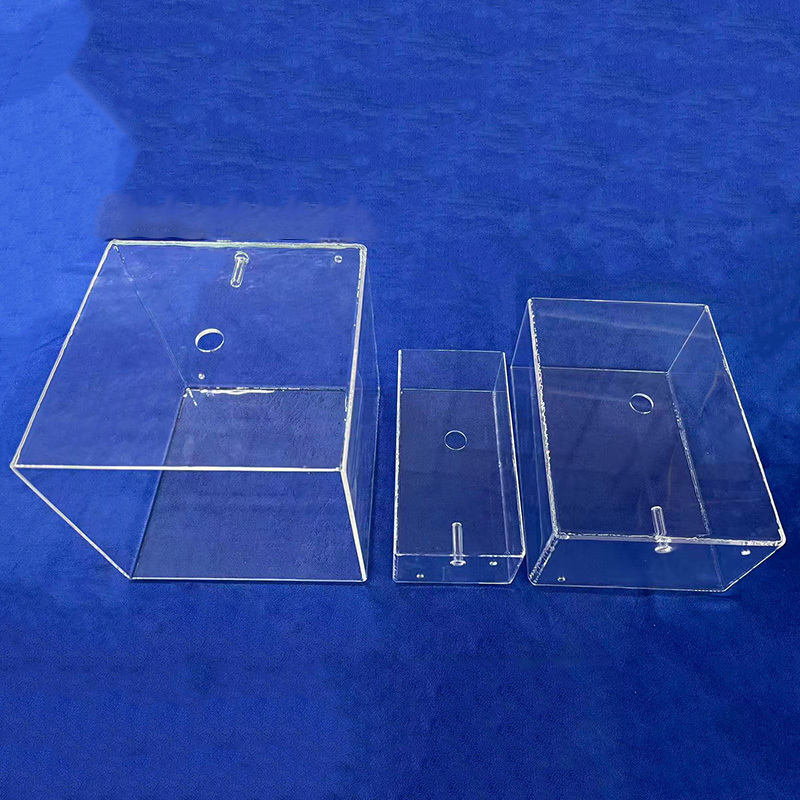
High Temperature Resistance Quartz Square Cells for Fuel Quality Testing-Mia
Gepubliceerd op: October 26, 2026
High Temperature Resistance Quartz Square Cells for Fuel Quality Testing
A fuel testing laboratory based in Japan specializing in petroleum product inspection, sulfur and trace hydrocarbon analysis contacted us for custom quartz square cells for their spectroscopic fuel quality testing systems. Previously, the testing team used conventional optical glass and polymer sample cells. When exposed to gasoline, diesel, biodiesel and mixed corrosive fuel additives, these conventional cells suffered from UV attenuation, surface swelling and trace substance leaching, leading to unstable spectral baselines and unreliable readings for low-level impurity detection.
In early communications, the laboratory team shared detailed testing specifications. They required high and consistent UV‑NIR light transmittance, excellent resistance to hydrocarbon solvents and fuel additives, stable performance under cyclic temperature changes during sample preheating, bubble‑free optical windows, polished inner cavity surfaces, and tight dimensional tolerance of ±0.03 mm for perfect fitting with their existing spectrometer fixtures. They also emphasized strict blank control, as trace leachable impurities would directly interfere with sulfur, aromatics and peroxide value quantification. Our technical team responded promptly, provided material optical spectra, impurity inspection reports and arranged free sample cells for on-site validation.
After receiving the samples, the client carried out repeated fuel immersion, thermal cycling, baseline stability and blank comparison tests over three weeks. They reported that glass and polymer cells caused obvious spectral drift and sample contamination after contact with fuel matrices, while our quartz square cells maintained stable optical performance with negligible substance release, delivering consistent, repeatable spectroscopic data for fuel samples. They confirmed the final drawing, window edge finishing and batch optical inspection standards before releasing the formal order.
The bulk quartz square cells were delivered on schedule. Used as optical sample chambers for fuel spectroscopic inspection and pre-treatment, they resolved the core issue of matrix interference and optical distortion. The testing team highlighted that the high purity and stable optical property of fused quartz were critical to meeting Japan’s strict petroleum testing standards.
Satisfied with both product consistency and our technical support workflow, the laboratory placed repeat follow-up orders and listed us as their preferred quartz consumable supplier. This case proves high‑purity quartz square cells are the reliable choice for precision fuel testing labs, where stable optical transmission and chemical inertness against hydrocarbon fuels are mandatory.

